Computational engineering
First-order vs higher-order finite elements
Improving finite-element accuracy often leads to a familiar choice: refine the mesh, increase the element order, or combine both in a controlled way.
Improving finite-element accuracy often leads to a familiar choice: refine the mesh, increase the element order, or combine both in a controlled way.
The basic difference
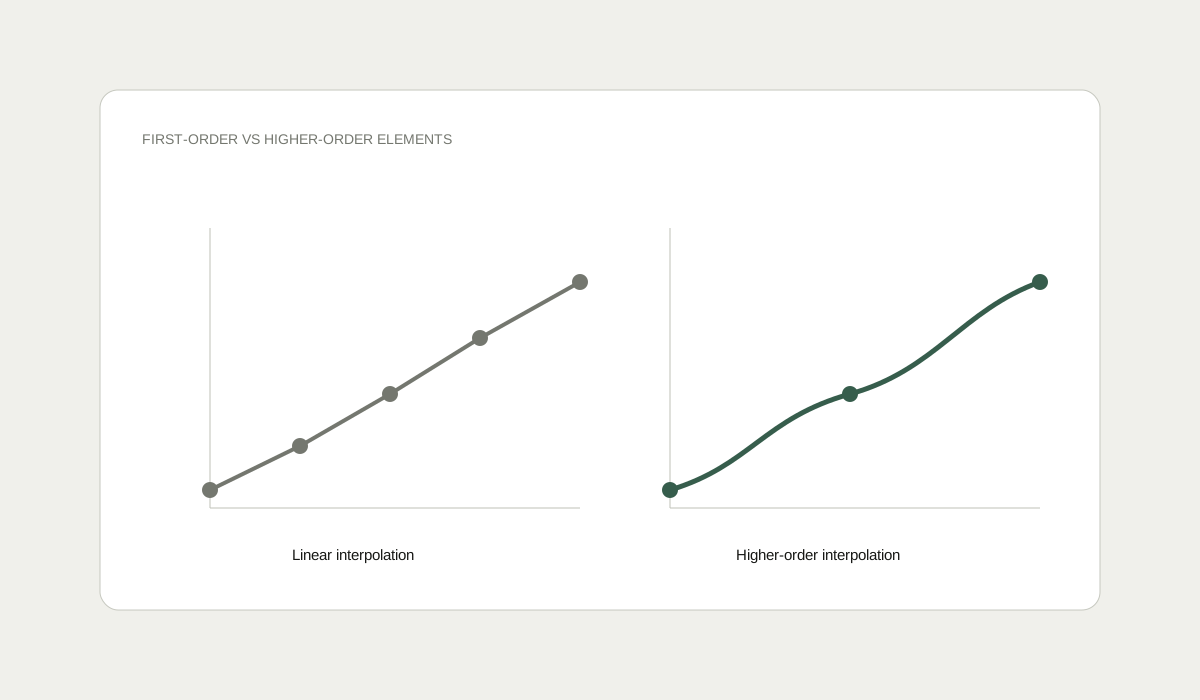
First-order elements use linear interpolation inside each element. Higher-order elements use quadratic or higher-degree interpolation and can represent smoother field variation with fewer elements.
The comparison is not simply cheap versus expensive. The right choice depends on geometry, solution smoothness, gradients, singularities, integration, conditioning and the quantity of interest.
What mesh refinement changes
Refining the mesh reduces the characteristic element size and improves spatial resolution. It can help near local gradients, geometric details, material interfaces and regions where the solution changes rapidly.
Uniform refinement is easy to apply but may spend many degrees of freedom in regions that were already adequately resolved.
Choose refinement based on the solution and the decision, then verify it with a convergence study.
What increasing polynomial order changes
Increasing the order improves the approximation available inside each element. For smooth solutions and well-represented geometry, this can produce rapid convergence.
Higher-order elements also increase per-element work, integration requirements and implementation complexity. Their benefit should be evaluated against total error for the quantity that matters.
A practical decision process
Begin with the expected regularity of the solution and the quality of the geometry representation. Use mesh studies or order studies rather than relying on a general rule.
For local singularities or discontinuities, targeted mesh refinement may be more effective. For smooth wave or structural fields, higher-order approximation can be attractive.
This article is a structured placeholder. Replace examples, claims, figures and references with the final reviewed version before publication.
A simple review table
| Question | What to document |
|---|---|
| What problem is being solved? | User, decision, physical system and operating range. |
| What evidence supports the method? | Reference cases, convergence, experiments, or high-fidelity comparison. |
| Where can it fail? | Boundary regimes, assumptions, invalid inputs and confidence limits. |
| How will it be used? | Workflow, interface, hand-offs and decision responsibility. |
References and further reading
- Replace with a primary paper, standard, or technical reference.
- Replace with relevant documentation or a project case study.
- Replace with a related article or external resource.

Mehul Bagaria
Entrepreneur and computational scientist working across engineering software, scientific machine learning and technical product development.