Scientific machine learning
Where physics enters operator-learning workflows
Physics can enter an operator-learning workflow through more than an explicit residual term. It can shape the problem definition, data, representation, architecture, constraints and evaluation.
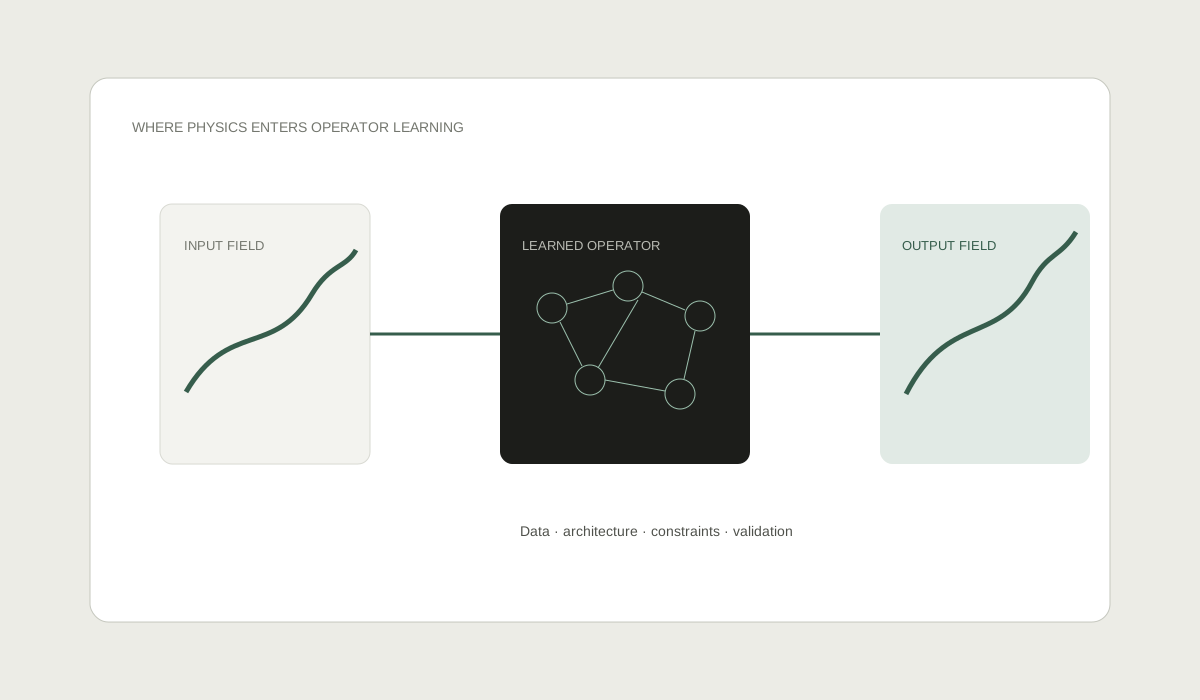
Physics can enter an operator-learning workflow through more than an explicit residual term. It can shape the problem definition, data, representation, architecture, constraints and evaluation.
Physics begins with the problem definition
The selected input and output fields determine which physical mapping the model is expected to learn. Boundary conditions, geometry, material parameters and operating regimes should be represented consistently with the intended use.
A model cannot preserve information that the formulation never provides.
The dataset carries modelling assumptions
When data comes from a numerical solver, its fidelity reflects the governing equations, discretisation, mesh, tolerances, parameter ranges and failure handling.
Coverage of the relevant function space matters more than a large case count alone. Sparse or biased sampling can produce a model that appears accurate but fails in important regimes.
Treat the complete workflow as the physics-informed system, not only the neural-network loss function.
Architecture and constraints encode structure
Equivariance, conservation-inspired layers, spectral representations, geometry handling, dimensional consistency and explicit physics losses are different ways to introduce prior structure.
No single mechanism guarantees physical behaviour. The choice should follow the failure modes and invariances of the problem.
Validation is where preservation is tested
Aggregate test loss is not enough. Evaluation should include physical quantities, difficult regimes, extrapolation boundaries, conservation checks and comparisons with the high-fidelity solver.
Physics preservation is therefore an empirical claim supported by targeted evidence, not only an architectural label.
This article is a structured placeholder. Replace examples, claims, figures and references with the final reviewed version before publication.
A simple review table
| Question | What to document |
|---|---|
| What problem is being solved? | User, decision, physical system and operating range. |
| What evidence supports the method? | Reference cases, convergence, experiments, or high-fidelity comparison. |
| Where can it fail? | Boundary regimes, assumptions, invalid inputs and confidence limits. |
| How will it be used? | Workflow, interface, hand-offs and decision responsibility. |
References and further reading
- Replace with a primary paper, standard, or technical reference.
- Replace with relevant documentation or a project case study.
- Replace with a related article or external resource.
Mehul Bagaria
Entrepreneur and computational scientist working across engineering software, scientific machine learning and technical product development.